Monday, April 27, 2009

Discover the Purest Neighbourhood of Valencia - The Carmen's Neighbourhood


Valencia is the third largest Spanish city in population and importance, after Madrid and Barcelona, and therefore one of the most surprising of the country. It has a wide range of events, monuments, festivals, etc. to see: the City of Art and Sciences, the America's Cup Competition, extraordinary beaches, and one of the most important festivals in Spain, Las Fallas. The bohemian Carmen neighbourhood is one of its many treasures. It extends from the River Turia to the north of the Central Market and has an interesting combination of modern cafés and historic buildings that give it a very peculiar atmosphere.

The Carmen's neighbourhood is thousand-year-old quarter and part of the the historical centre of the city that has developed between three walls: a Muslim one from the Eleventh century, that limited the East side; the Christian one from Fourteenth century, that limited the West side; and the wall that covered the suburbs. Therefore, a system of portals was created to solve the problems of communication that having so many walls presented.

The person who has not visited the Carmen's neighbourhood, can not really say he knows Valencia, as it is the purest district of the city. The Central Square is the heart of the area and the leisure center. The neighbourhood takes its name from the Carmen de Calzado Church, around which the population was settled centuries ago.

The traveller should not miss the Valldigna Portal, the Serrano's Towers and the Quart's Towers, the Round Square, the Beneficencia Cultural Centre, the famous Carmen's Church and several museums scattered around the area.

Furthermore, the Carmen's neighbourhood is one of the best choices to go party. All the bars, restaurants and pubs have a bohemian atmosphere are full of people. Calle Alta Street and the Virgin Square are both much appreciated areas in the quarter.

What are you waiting for? Take the first fly to Valencia. Rent the best Valencia Apartments and enjoy your stay in the city.

Thursday, April 23, 2009

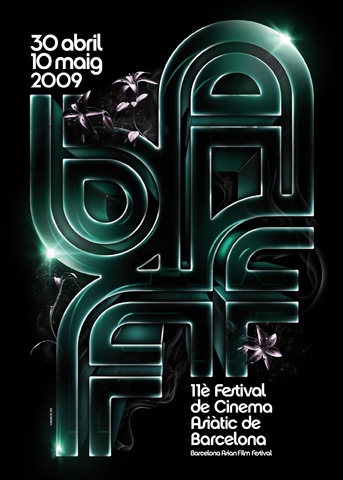
Asian Film Festival of Barcelona - BAFF 2009


Once again, Barcelona hosts one of the most interesting cinematographic festivals of the current panorama, the Asian Film Festival of Barcelona - BAFF 2009. From April 30th to May 10th, the city will witness the largest showcase of Asian cinema in Spain. The event, directed by Carlos R. Ríos and Amaia Torrecilla and organized by 100,000 retinas, celebrates its eleventh edition with more acceptance than ever and looks to Japan as the new Asian cinema promise.

This year the festival presents many innovations: for the first time the NETPAC prize will be granted to the best Asian movie presented in other festivals such as Venice, Cannes, Rótterdam or Berlin. A new section will be created for the novice directors - who are the future promises of Asian cinema, and their works and the "Guest Country" has been removed to promote new sections that will focus on all cities, directors and film themes.

The awards will be divided into the following sections: the Durián de Oro Award for the best film, which is given by Asia House with a prize of 6,000 euros to the director whose filmography does not exceed three movies; the D-Cinema Award, for the best movie made in this format; and the Cinematk Award, that will distribute throughout Spain the awarded film and its exclusive showing on the Cinematk TV channel.

This year 14 films will participate in the official section. The movies come from countries such as Thailand, Taiwan, Indonesia, Japan, South Korea, Malaysia and China / Hong Kong, among others. Standing out is the participation of a great number of new directors, but also some consolidated ones such as Naomi Kawase, who presents her latest film. Furthermore, BAFF is honoured to present in Spain the Oscar winning film Departures, of Takito Yojiro. Other important titles are "Ocean Flame", "Blind pig who wants to fly" by Junji Sakamoto "Chameleon" by Kim Ki-duk ("Dream"), Takeshi Kitano ("Achilles and the Tortoise"). Among so much cutting edge work, it's hard to make a list of the best works at this festival.

These are the official spaces for the festival: CCCB, the Aribau Club Cinema, the Caja Madrid Cultural Centre and the Rex Cinema. The tickets, which can be purchased in advance via telentrada.com and servicaixa.com, cost 6 Euros per individual session, or 25 Euros for 5 sessions, and 45 Euros for 10 sessions.

The BAFF festival has helped Asian movies to gain greater appreciation and shake off its "cult cine" tag. In the past ten years, the festival has discovered great talents who are today's heavyweights of the contemporary film scene. Rent your Apartments in Barcelona now and enjoy the best Asian cinema in the city.

Primavera Sound 2009


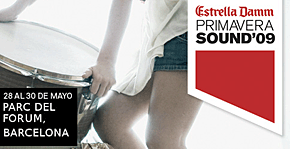
The season of festivals and concerts approaches. The spring, besides good weather, brings an endless number of music festivals of all genres. Among them, highlights the festival of festivals of Europe, the favourite for music lovers, The Primavera Sound!

This way, from May 28th to May 30th the Parc del Fòrum of Barcelona will be the incomparable frame where the music, the Sun and the sea will fuse to do of the Primavera Sound the festival of the year.

From 29th -30th May the Parc del Forum in Barcelona will be the amazing backdrop where music, sun and the sea will all fuse together to make Primavera Sound this year's unforgettable music festival. In addition, it presents an excellent line-up.

One of the stars of this year's edition is Neil Young. It also highlights Ezra Furman & the Harpoons, offering rock tinged with folk and punk. From the Catalan territory come El Gremio and the the DJ of the famous musical blog 20JazzFunkGreats. Another group to highlight is of The Faith Healers, who return to the stages. The British band The Horrors is back with a new style that will provide a lot to talk about. Maika Makovski will also present their latest work. The great Tokyo Sex Destruction accompanied by Gregg Foreman, ex-leader of The Delta 72 and component of the live band Cat Power, will delight the public. And finaly, we can't forget to talk about The Bats.

As has happened other years, the Sidecar and Apollo concert halls will recieve several showcases in the days previous to the festival. The guest artists are Dälek, Reigning Sound, The Intelligence, Zu, or Half Foot Outside, among others.

On the other hand, there will be celebrated some concerts taking place at L'Auditori: Michael Nyman, My Bloody Valentine, Joe Henry, Damien Jurado, Bad Plus, Alela Diane, The New Year and Extra Life. Suitable for all tastes!

Once again there will be the "Primavera Sound goes into the Metro Station", with Mujeres Centella, QA´A y Gúdar.

The tickets cost € 155 for the three days or € 70 for just one day. You can buy them at internet Ticketmaster (Tick Tack Ticket), the CD stores Drome in Barcelona and Madrid, the RIFT stores in Barcelona and Sitges, Entradas.com, FNAC France, UK Seetickets and PayPal via the web festival.

Take the first flight to Barcelona and come to this great music festival. For the best accommodation, rent Barcelona Apartments. Enjoy your stay!

Sunday, April 19, 2009

The Literary Barcelona


Barcelona is a captivating city. Perhaps that is why for centuries hundreds of writers have let themselves be taken in by its beauty. Therefore it has become a literary city: its magic, its charm, its different cultures... Who has not ever read a text inspired by Barcelona? Already in the nineteenth century the city was a worship center for many writers. The French writers Carce, Bourget, Pieyre de Mandiargues and Genet, and the Catalans writers Narcis Oller and Antoni Altadill gave us the first Barcelona's ideologies.

There are so many books based on Barcelona, thtat people don't distinguish the where begins the real city and where ends the imaginary one. It has been invented so many times between pages and ink! It is a network of past and present, glories and miseries, rich people and poor people, hapless and artists, suburban prostitutes and exquisite high class escort girls...

The greatest writers have chosen Barcelona as the basis for his novels: starting with the unique Miguel de Cervantes, who presented Barcelona as the unique urban setting in Don Quixote; it was exalted to the highest level in the verses Joan Maragall and Jacint Verdaguer; even Orwell wrote about it as a revolutionary frame; Josep Pla related the details of its daily live; Jean Genet looked after its dark side and Eduardo Mendoza, Vázquez Montalbán, Carlos Ruiz Zafón or Juan Marsé gave it a international prestige.

The city has stolen the heart and the pen of the greatest writers. Therefore, most novelists do not have enough to live in the city, but they have had to reinvent it with their pens.

What would have been of the Raval neibourhood without the famous detective Pepe Cravalho (by Manuel Vázquez Montalbán)? And what about the Gracia quarter without the books of Mercè Rodorera? Who has not shared the exploits of the characters of Eduardo Mendoza? Thanks to all these writers Barcelona has a strong literary web woven with threads of ink. For the literature lovers it will be a real pleasure to walk the main streets of the city through the "literary tours" that some agencies offer...

Would you like to go on with the story of The Shadow of the Wind (by Carlos Ruiz Zafón) or La Catedral del Mar (by Ildefonso Falcones)? Come to this beautiful city and rent Barcelona Apartmetns.

Tuesday, April 14, 2009

Tattoos - An Art As Old As Man


Are you one of those who think that tattoos are just a passenger fashion? If so, you are wrong. The tattoo art is as ancient as the human race. Even a mummy of the Neolithic period with 57 tattoos in his back has been found! Surprised? Polynesia was the first region in the world to practice the art of tattooing, as well as the pioneer in using it as something purely aesthetic.

For centuries, various cultures have used tattoos in many different ways: some of them considered it an art, as Japan; other used them as a way of social stigma, as the ancient Rome and Greece; others as a symbol of maturity, as North America; and even there were some cultures that have attributed supernatural powers to them, as Egypt. Over the years its function has changed and today, the tattoos are used exclusively as a body ornament. The techniques have been refined to the point of turning it into an art-form. Now the tattoo artists have become masters of drawing and they design beautiful images with the skin as canvas. The tattoos have become a real boom!

The tattoos have been gradually integrated into society and today they are standardized among all social sectors. Increasingly there are more tattooed bodies around the world. So it is not strange that every year various tattoo conventions are held across the globe, such as the "Berlin International Tattoo Convention", one of the largest in the world (celebrated since 1991). There participate the best tattoo artists of the world. In fact, Berlin is considered one of the tattoo cradles in Europe.

To many people to get tattoo represent a way of worshipping the body; on the other hand, to others they represent a form of expression and a way of life. The tattoos show off many own styles. They tell people that they belong to a code, a tribe or a group.

Today there is a regulation to which all the tattoo studios must adhere: single-use instruments (syringes and needles); they should be unsealed in the presence of the user; they should be perfectly sterilized; obligatory vaccination of staff against hepatitis B, tetanus and diphtheria; they will have to certify the completion of a training course on hygiene and health of 30 hours amongst other things.

Tattos are setting trends! Travel to the German capital and discover why. Rent the best Berlin Apartments and enjoy a pleasant stay in the city.

Wednesday, April 8, 2009

The Most Fashionable District of Barcelona - El Born


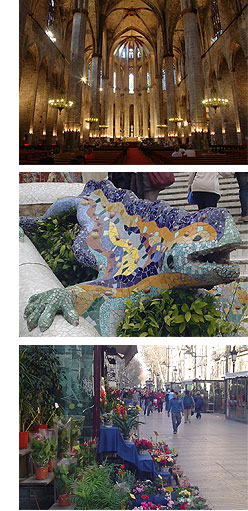
El Born is undoubtedly the most charming district of Barcelona. Every corner is full, pleasant and charming surprises. From its small streets, passing through its majestic Rambla, the Ciutadella park, the beautiful Santa Caterina market or the solemn cathedral of Santa Maria del Mar, nothing in the Born district will leave you indifferent.

El Born was formerly known as the Ribera (the Bank) district, due to a huge irrigation ditch that crossed the quarter and brought water in from the Besós River. In the Ribera neighbourhood merchants and sailors used to live together but as time passed by palaces were built some museums: the Textile and Clothing Museum, the Barbier-Mueller Pre-Columbian art Museum or the famous Picasso Museum.

Today, Born is the most fashionable district of Barcelona. One of its greatest charms is that it still preserves its medieval structure almost intact. It offers a wide range of culture and leisure: the best design bars and restaurants, unique boutiques, museums, galleries, theatres...

El Born is situated between La Barceloneta Quarter and Via Laietana Street. Its main street is the famous Paseo del Born, a charming street lined with restaurants, bars and shops topped off by the jewel of the district, the Gothic church of Santa Maria del Mar.

One of the side streets to Paseo del Born, Montcada Street, houses one of the most famous museums of Barcelona: Picasso Museum. The other nearby streets have an intense medieval air and are filled with shops and incredible restaurants.

The Palau de la Música Catalana, designed by the architect Domenech i Montaner, is another mandatory stop in el Born district. This is an amazing modernist building and one of the jewels of Catalan architecture. The Santa Caterina Market, is located just a few minutes walk from the Palau. It is the last market built in the city, but a mandatory stop too. It was built by Enric Miralles and Benedetta Tagliabue amd it is famous thanks to its corrugated and colourful ceramic roof.

Finally, the Parc de la Ciutadella is the lung of the district, and one of the most beautiful green areas of Barcelona. Formerly it housed a military citadel which still retains some military installations as the arsenal, the governor's palace which is now a school, and the chapel. In addition, this park houses: the Geology Museum, de Zoology Museum, the Barcelona Zoo, the Hivernacle (today it houses a café) and the Umbracle (a beautiful greenhouse made of brick and wood). There is a lake where you can hire small rowing boats. Every year from April 1st the Spring Festival is celebrated here. There are workshops organized, shows, festivals, performances and games for all the family.

Rent the best Apartments in Barcelona for the best accommodation in the city. You'll enjoy it!

Monday, March 30, 2009

Budapest Gastronomy


Budapest is a city rich in culture, art and customs, which was named "Spa City" thanks to the huge number of springs it has. But it has much more to offer, such as its delicious cuisine, unique in flavours and recipes.

The Hungarian cuisine has been influenced by multiple cultures throughout its history. It has Austrian, French and Italian influences. It is rich in spicy flavours and aromas, thanks to the paprika, the most used ingredient. Among its favourite dishes there are soups, stews, fish and meat. Although gulash is undoubtedly the star Hungarian recipe.

In Hungary the restaurants could be classified in two ways: on the one hand, there are the "vendégló", which are more traditional restaurants where it is possible to taste the best home-cooked typical local food; on the other hand, there are design locals, where food is more refined and delicious recipes are served.

Among the most common dishes you'll find meat, especially game, which is served grilled or roasted. Their favourite recipes are "csirkepaprikás", paprika chicken; "porkolt", a variety meat stew; beef broth with marrow; "roston", roasted meat; and salami (known as "téliszalámi"), which is one of the best known international Hungarian products. However, "gulash" (a thick soup made with small meat cubes with potatoes and "csipetke") is the star inside and outside its borders. The "újházi tyúkhúsleves" is another type of chicken soup with peas, mushrooms, carrots and pasta.

Fish lovers are in luck too. There is a delicious fish soup called "halaszle" (fish, onions and paprika) they should try. Rather typical of this place are the excellent fresh water fish such as pike, catfish or trout. "Paprika fish" ("halpaprikás") are very popular too (soups that include at least three kinds of fish, onions and paprika).

A popular ingredient to cook is "tejföl" (fresh cheese such as "quark" which intensifies the flavours). Main dishes are served with pasta, rice and "tarhonya" (meatballs). They are also very common vegetables and salads.

The pastry is a specialty of the country. The most typical desserts are the "túrós csusza", sweet warm cakes filled with curd; the "pancakes"; the "palacsinta", an omelette filled with raisins, ground walnuts and lemon covered with chocolate cream; and the "somló", a sponge cake with cream and rum. Hungarian wines are very famous too.

Discover why the Hungarian cuisine is one of the most delicious of Europe! Rent Budapest Apartments and enjoy your stay!

Budapest, the "Spa City"


Budapest was appointed "Spa City" in 1934 for its huge amount of curative and thermal springs. This city has 118 wells with 70 million litres of water at temperatures ranging between 21 and 80 ° C. Thanks to its mineral these waters heal many ailments. Many of the spas of Budapest date from Roman times, but only since the twentieth century people began to be used them for treatment of diseases.

Some spas are transformed into nightclubs every weekend. Aquatic parties called "Cinetrip Parties" or "Magic Baths" are organized, where young people dance and have fun in the pools.

Aside from these parties, most of the public baths are not mixed. Some of them are exclusive for men or for women and other reserve a few days for each sex. But there are also some spas in which both sexes can be mixed.

Széchenyi Spa

The Széchenyi Spa was inaugurated in 1913 and it is one of the largest spas in Europe. It has 15 pools: 3 large outdoor pools and 12 small covered pools. It has Turkish baths, saunas, massage service and diving pools too. One of the main attractions are the chess matches that are disputed in the warmer outdoor pool (37 ° C), where tourists and locals challenge each other to games and spend a pleasant time.

Shelude: todos los días de 6.00 a 22.00 horas
Address: District 14. Állatkerti Avenue, 11

Gellért Spa

It is one of the oldest spas of Budapest. This is a beautiful place thanks to its spectacular marble columns, its colourful Zsolnay mosaics, its statues, its beautiful stained glass windows, it modernist furniture and it 700m square atrium with a beautiful glass roof. The spa is located inside the Gellért hotel. It has 9 pools: an outdoor wave pool, a thermal water pool, a children's pool and a covered effervescent pool. It also has a sauna and massage services.

Shelude: weekdays: from 6.00 to 19.00, weekends: from 6.00 to 17.00
Adress: District 11. Kelenhegyi Street, 4

Budapest is waiting for you. Rent Budapest apartments and enjoy your travel!

Tuesday, March 24, 2009

Barcelona Outlets - The Cheapest Prices of Major Brands


Maybe you are one of those passionate of shopping and top labels... Has the financial crisis affected your wallet and your wardrobe? The high prices of major brands articles are an impediment to buy them in these crisis times. So, you have to renounce the quality to acquire better offers. Stop! Outlet stores are proliferating: you'll find all kinds of top quality labels at reasonable prices - they're usually leftovers from past seasons.

La Roca Village is one of the major commercial centres dedicated just to Outlets of quality brands. It imitates a village with a main street flanked by hundreds of top labels stores: Antonio Miro, Billabong, Burberry, Cacharel, Calvin Klein, Corso Italia, Gant, Hugo Boss, Levis, Loewe, Polo Ralph Lauren and Swarovski, among many others. Find the best clothing, cosmetics, home furnishings... Everything you wish at discounted prices up to 60%!

Another Outlet shopping centre is Heron City where you'll find discounts of up to 70% in all kind of stores.

There are also great stores to decorate your home at an accessible price. There are many establishments which sell appliances with slight defects:

1. Stock (C/Guifrè el Pilos, 7 - Can Vinyals Industrial Park, Santa Perpetua de Mogoda),

2. Rohymaz (C/Pompeu Fabra, 75, Mollet del Vallés) or Factory Appliances (A7 road, Cardedeu - Carretera de les Aigües - no number)

To dress up your home go to:

1. Zabriskiestudio (C/Mallorca, 198)
2. Stock House (C/Balmes 67)
3. La Perla Gris Outlet (C/Consell de Cent, 300)

There are also Outlets for children or mothers:

1.Boboli Outlet (C/Valencia, 654)
2. Prenatal 2 (C/Portaferrisa, inside the Maldá Galleries)

Rent Barcelona Apartments and enjoy this beautiful city and its incredible economic prices!

Monday, March 23, 2009

Berlin, European Capital of the Gay World


Berlin is a cosmopolitan and modern city, very committed to the gay cause. Because of that it is one of the three gay capitals in Europe, together with London and Amsterdam. Even its town's mayor, Klaus Wowereit, has declared himself openly gay.

There isn't an unique gay neighbourhood in the city, as Chueca in Madrid, but everything is widespread throughout the city. Throughout all the neighbourhoods the rainbow flags are waving.

The ancient East area, now Schönhauser Allee, stands out for its great quantity alternative bars, restaurants and clubs. This area, close to Alexanderplatz, is frequented by gays and lesbians and houses popular locals such as Kinzer or GMF @ Café Moskau. In Kreuzberg there are renowned clubs like SchwuZ (the most famous one), Serena Bar, SO36 or Culture Club. Kreuzberg and Berlin-Mitte are the favourite areas for girls

The ancient West Area is a prominently male atmosphere and it is concentrated around the Nollendorf Square in Schöneberg. At that place, a commemorative monument as a reminder to the homosexual victims of the Nazi regime was put up. There the first gay bars were open and the neighbourhood became the gay culture center in Berlin. In this quarter there is a large concentration of gay and gay-friendly hotels and "men only" premises (Rob, Man's, Jaxx, Mr.B). But there are plenty of mixed bars or pubs for straight people.

The Gay Pride in Berlin is one of the biggest of the old continent, with half a million people taking part. Are you going to miss it? Rent Berlin Apartments and discover a beautiful gay atmosphere!

Holy Week in Andalucia


The Holy Week is one of the most representative religious festivals in Spain, which is celebrated throughout the country. But if there is a region that lives it with a special fervour, that is Andalusia. There are thousands of tourists who flock to Andalusia to enjoy Holy Week, which is celebrated during the week of the first full moon of spring. This Christian festival commemorates the death and resurrection of Jesus, in addition to the Passion of Christ.

The Holy Week begins with the end of the Lent (from Palm Sunday to Holy Wednesday) and finishes with the Holy Triduum (Holy Thursday, Good Friday, Hly Saturday and Sunday of the Resurrection). About 60 Brotherhoods leave in procession with images of the Virgin and the Passion of Christ to the delight tourists and locals.

The processions are sorted parades followed by rows of penitents or Nazarenes with candles. Usually sounds instrumental music with the parades, unless they are silent processions.

The case of the Seville Holy Week is very special. This is one of the most important in Spain. It enjoys an international reputation within the Catholic world and it has been declared a public holiday of International Tourist Interest.

People in Seville venerate the following saints: the "Señor de Sevilla", the "Virgen de la Macarena y la Esperanza de Triana", the "Cristo de la Expiración (Cachorro) " and the "Cristo del Gran Poder".

But in addition to a religious festival, Easter is an important cultural event. Discover why travelling to Andalusia. Rent Seville Apartments for the best accommodation.

Friday, March 20, 2009

Seville's April Fair


Spring is in the air and in Seville one notices that a festive atmosphere is fast approaching. Within a very short time (from 28th April to 3rd May), the April Fair in Seville will be held and is one of the most famous celebrations both in Andalusia and Spain. This fair dates back to 1846, when two men asked the City Council for an annual cattle fair for the city. Since then, it has changed a lot and it has become what we now know as the Seville April Fair.

This is the most relevant festival in Andalusia and the one that receives the most tourists together with the Holy Week or Semana Santa. It is also an indispensable meeting point for Sevillian people. For seven whole days people eat, drink, dance and have fun at the fair.

The celebration begins with the "Enlightened Monday" ceremony and with a traditional fish dinner. To close it, after seven days of intense fun, fireworks are launched and the traditional bull fights take place.

The fairground enclosure is a replica of Seville and it is established in the Remedios neighbourhood. The streets have names of famous bullfighters: Joselito El Gallo, Curro Romero and Ricardo Torres "Bombita". In addition, they put up lots of marquees or little tents decorated with rainbow lanterns and the Town hall rewards the most beautiful one.

In the mornings, the streets of the fairground are filled with people who want to see the horse drawn carriages, horsemen and "flamencas". Everyone eats the typical fried fish and drinks "manzanilla" or "fino" (sweet wine). In the evening the mythical bull runs are celebrated with the great bullfighting masters in the Maestranza bullring. Then the party continues until dawn.

The April Fair is the perfect place to eat, to drink, to dance "sevillanas" and to have a great time. There are many places to relax or have fun, plus a host of stalls selling all kinds of food and drink.

Are you going to miss this fabulous Spring Fair? Travel to Andalusia and rent Seville Apartments to find the best accommodation.

Friday, March 13, 2009

Barcelona's Raval


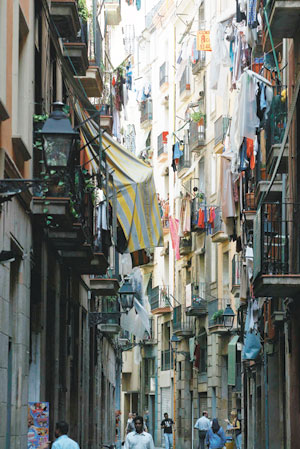
The Raval neighbourhood was historically the slum of the ancient Barcelona. However, it has become the most fashionable area in the city. Lots of bohemian and cool bars and clubs now fill its alleyways. If you are into new tendencies, the Barcelona Raval is your quarter! But it is still a good idea to take care with your wallet and backpack at night. It has a unique personality that makes it special. Although it is an exciting area in the city, it also has its darker side.

The Raval neighbourhood represents a refreshing and authentic area of Barcelona. It used to be the famous Barcelona's red-light district. The government started an urban regeneration project for the Olympics to clean up the area and becomes it safer. But there are still some unsafe areas, where drugs, theft and prostitution continue. However, it is a vibrant, lively and multicultural quarter!

It enjoys has a multitude of fashionable and ethnic restaurants, pubs, clubs and bars and a wide variety of art studios, galleries, such as the famous MACBA (museum of modern art) and CCCB (an exhibition centre). There are lot of shops, and unique boutiques that you'll find only in the area. Here you'll find the small privately owned shops!

Discover the Rambla del Raval. This is a new space gained to the neighbourhood. This is a lovely avenue, dominated by Arab people. Hence, this quarter is also known as the Little Islamabad or as Ravalkistan. In this quarter there live foreign families, especially from Morocco, Pakistan, India, Bangla Desh and South America...

The Marsella bar is a mandatory stop (Sant Pau street). First it was a distinguished coffee for high class Gentlemen, but eventually it became the central point of the singles scene. Another treasures in the Sant Pau Street are the beautiful modernist decorations of the Hotel Spain lounges, designed by Domenech i Muntaner.

The Raval neighbourhood is a fascinating quarter. Discover it wondering through its small narrowstreets, or as they used to say in Barcelona, "ravaleando". Rent Barcelona Apartments for the best stay in the city.

Monday, March 9, 2009

When Football Raises Passions - Barca Vs Real Madrid


Football is for many people much more than sport. This has become the most popular game on the planet, with nearly 270 million people participating in one way or another. In Spain, soccer moves astronomical amounts of money on advertising alone, with Barça and Real Madrid with the most capital invested in promotion. In addition, these two clubs have the most followers. Even their players have become media stars just like singers and actors.

In fact, the enthusiasm for football in Spain has reached astonishing levels: the stadiums of both teams are among the most visited attractions in both cities. In addition, the Museum of Barcelona FC is the most visited museum in Catalonia, ahead of other well-known ones such as the Dalí museum.

Barca and Real Madrid are two of the most famous teams in the world and in our country they have always been eternal rivals. Madrid was named Best Club of the century by FIFA in 2000. they have won 31 league titles, 17 Copa del Rey, 8 Spanish Super Cups, 9 Champion's Leagues, 2 UEFA Cups, 1 European Supercup and Intercontinental Cups 3.

Considering Barça, it has been the only European team that has played continuously in the continental competitions since its beginnings in 1955. Moreover, it has attained 18 league titles, 24 Copas del Rey, 7 Spanish Super Cups, 2 European Super Cups, 2 Champion's League titles, 4 European Cup Winner's Cups and 3 European Fairs Cups among others.

Both Culès as well as Meringues have been blessed with the best soccer stars. Barca have signed players such as Messi, Cruyff, Maradona, Laudrup, Ronaldinho or Kubala, while Real Madrid have signed stars such as Zidane, Di Stefano, Casillas, Raul, Ronaldo and Puskas.

At the moment FC Barcelona and Real Madrid are fighting for the top two positions in the table with Barcelona ahead by just a few points. What seemed impossible a few days ago when a seemingly invincible Barça were 12 points ahead, is now much more of a target for Real Madrid.

We will have to wait until 3rd May for the eternal rivals to face each other again. Undoubtedly, it will be a game to provoke heart attacks as one side is speaking of a crisis in the Barça camp while the whites are enjoying a good run of unbeaten games.

Does anyone dare to bet on who will win the league? With so few days to go until the end of the league, emotions are running at an all time high. The match will be played at the Santiago Bernabeu in Madrid so why not enjoy the game in style - rent the best apartments in Madrid so as not to miss a thing!

Monday, March 2, 2009

Sintra - A Fantastic City


Sintra is one of the most beautiful towns in Europe. It belongs to Portugal and it is located close to Lisbon. It was known in ancient times as Mons Lunae (the Hills of the Moon), because of its strong traditions in astral cults. Sintra has been declared World Heritage by UNESCO due to the large amount of archaeological remains and monuments it has.

It is a very tourist town because it enjoys of a rich cultural heritage. It tourist potentialities also include the three National Palaces: Palácio da Vila and Palácio de Queluz and Palácio da Pena, in addition to the municipal museums. It also includes the quarries producing marble, winegrowing, the confectionery and gastronomy and the handicraft workshops.

Thanks to its unique combination of castles, parks and gardens, Sintra enjoys a beautiful and unusual geography. The city centre is about 15 minutes by walk from the train station. The Sintra's heart is a real gem: everything there seems as if you were in a fairy tale. There is a wonderful Toy Museum for young and old people, lots of craft shops, pastry shops and restaurants. The Jardins de Monserrate are a must. They have a huge variety of subtropical plants and exotic trees. Not to be missed are the palaces of Seteais and Monserrate and the Moorish Castle dates from the 8th century.

There are any other mandatory places to visit: the Convento dos Capuchos, : the 12th Century Igreja de Santa Maria or some several private palaces that are open to the public: the Palácio de Seteais, a magnificent 18th Century home transformed into a five star Hotel; Casa dos Ribafrias, a 16th Century building Quinta de Pena Verde, another 16th Century palace, and the Palácio de Monserrate, built in the 19th Century.

There are also many museums to visit: the Casa Museu Leal de Câmara, which shows the Palace's art works; the Museu Regional, which shows the area's history; Museu de Arte Moderna, the Casa Museu Dorita Castel Branco and the Galeria de Arte Municipal among others.

Sintra lies along a wonderful coast, so it has beautiful beaches. Do you need any other reason to go to Portugal? Take the first train to Sintra and rent Lisbon Apartment. As Robert Southey once wrote: "Sintra is the most blessed place of all the habitable world".
 
Blog Information Profile for fernandoseo
Bookmark and Share Add to Technorati Favorites