Tuesday, March 24, 2009

Barcelona Outlets - The Cheapest Prices of Major Brands


Maybe you are one of those passionate of shopping and top labels... Has the financial crisis affected your wallet and your wardrobe? The high prices of major brands articles are an impediment to buy them in these crisis times. So, you have to renounce the quality to acquire better offers. Stop! Outlet stores are proliferating: you'll find all kinds of top quality labels at reasonable prices - they're usually leftovers from past seasons.

La Roca Village is one of the major commercial centres dedicated just to Outlets of quality brands. It imitates a village with a main street flanked by hundreds of top labels stores: Antonio Miro, Billabong, Burberry, Cacharel, Calvin Klein, Corso Italia, Gant, Hugo Boss, Levis, Loewe, Polo Ralph Lauren and Swarovski, among many others. Find the best clothing, cosmetics, home furnishings... Everything you wish at discounted prices up to 60%!

Another Outlet shopping centre is Heron City where you'll find discounts of up to 70% in all kind of stores.

There are also great stores to decorate your home at an accessible price. There are many establishments which sell appliances with slight defects:

1. Stock (C/Guifrè el Pilos, 7 - Can Vinyals Industrial Park, Santa Perpetua de Mogoda),

2. Rohymaz (C/Pompeu Fabra, 75, Mollet del Vallés) or Factory Appliances (A7 road, Cardedeu - Carretera de les Aigües - no number)

To dress up your home go to:

1. Zabriskiestudio (C/Mallorca, 198)
2. Stock House (C/Balmes 67)
3. La Perla Gris Outlet (C/Consell de Cent, 300)

There are also Outlets for children or mothers:

1.Boboli Outlet (C/Valencia, 654)
2. Prenatal 2 (C/Portaferrisa, inside the Maldá Galleries)

Rent Barcelona Apartments and enjoy this beautiful city and its incredible economic prices!

Monday, March 23, 2009

Berlin, European Capital of the Gay World


Berlin is a cosmopolitan and modern city, very committed to the gay cause. Because of that it is one of the three gay capitals in Europe, together with London and Amsterdam. Even its town's mayor, Klaus Wowereit, has declared himself openly gay.

There isn't an unique gay neighbourhood in the city, as Chueca in Madrid, but everything is widespread throughout the city. Throughout all the neighbourhoods the rainbow flags are waving.

The ancient East area, now Schönhauser Allee, stands out for its great quantity alternative bars, restaurants and clubs. This area, close to Alexanderplatz, is frequented by gays and lesbians and houses popular locals such as Kinzer or GMF @ Café Moskau. In Kreuzberg there are renowned clubs like SchwuZ (the most famous one), Serena Bar, SO36 or Culture Club. Kreuzberg and Berlin-Mitte are the favourite areas for girls

The ancient West Area is a prominently male atmosphere and it is concentrated around the Nollendorf Square in Schöneberg. At that place, a commemorative monument as a reminder to the homosexual victims of the Nazi regime was put up. There the first gay bars were open and the neighbourhood became the gay culture center in Berlin. In this quarter there is a large concentration of gay and gay-friendly hotels and "men only" premises (Rob, Man's, Jaxx, Mr.B). But there are plenty of mixed bars or pubs for straight people.

The Gay Pride in Berlin is one of the biggest of the old continent, with half a million people taking part. Are you going to miss it? Rent Berlin Apartments and discover a beautiful gay atmosphere!

Holy Week in Andalucia


The Holy Week is one of the most representative religious festivals in Spain, which is celebrated throughout the country. But if there is a region that lives it with a special fervour, that is Andalusia. There are thousands of tourists who flock to Andalusia to enjoy Holy Week, which is celebrated during the week of the first full moon of spring. This Christian festival commemorates the death and resurrection of Jesus, in addition to the Passion of Christ.

The Holy Week begins with the end of the Lent (from Palm Sunday to Holy Wednesday) and finishes with the Holy Triduum (Holy Thursday, Good Friday, Hly Saturday and Sunday of the Resurrection). About 60 Brotherhoods leave in procession with images of the Virgin and the Passion of Christ to the delight tourists and locals.

The processions are sorted parades followed by rows of penitents or Nazarenes with candles. Usually sounds instrumental music with the parades, unless they are silent processions.

The case of the Seville Holy Week is very special. This is one of the most important in Spain. It enjoys an international reputation within the Catholic world and it has been declared a public holiday of International Tourist Interest.

People in Seville venerate the following saints: the "Señor de Sevilla", the "Virgen de la Macarena y la Esperanza de Triana", the "Cristo de la Expiración (Cachorro) " and the "Cristo del Gran Poder".

But in addition to a religious festival, Easter is an important cultural event. Discover why travelling to Andalusia. Rent Seville Apartments for the best accommodation.

Friday, March 20, 2009

Seville's April Fair


Spring is in the air and in Seville one notices that a festive atmosphere is fast approaching. Within a very short time (from 28th April to 3rd May), the April Fair in Seville will be held and is one of the most famous celebrations both in Andalusia and Spain. This fair dates back to 1846, when two men asked the City Council for an annual cattle fair for the city. Since then, it has changed a lot and it has become what we now know as the Seville April Fair.

This is the most relevant festival in Andalusia and the one that receives the most tourists together with the Holy Week or Semana Santa. It is also an indispensable meeting point for Sevillian people. For seven whole days people eat, drink, dance and have fun at the fair.

The celebration begins with the "Enlightened Monday" ceremony and with a traditional fish dinner. To close it, after seven days of intense fun, fireworks are launched and the traditional bull fights take place.

The fairground enclosure is a replica of Seville and it is established in the Remedios neighbourhood. The streets have names of famous bullfighters: Joselito El Gallo, Curro Romero and Ricardo Torres "Bombita". In addition, they put up lots of marquees or little tents decorated with rainbow lanterns and the Town hall rewards the most beautiful one.

In the mornings, the streets of the fairground are filled with people who want to see the horse drawn carriages, horsemen and "flamencas". Everyone eats the typical fried fish and drinks "manzanilla" or "fino" (sweet wine). In the evening the mythical bull runs are celebrated with the great bullfighting masters in the Maestranza bullring. Then the party continues until dawn.

The April Fair is the perfect place to eat, to drink, to dance "sevillanas" and to have a great time. There are many places to relax or have fun, plus a host of stalls selling all kinds of food and drink.

Are you going to miss this fabulous Spring Fair? Travel to Andalusia and rent Seville Apartments to find the best accommodation.

Friday, March 13, 2009

Barcelona's Raval


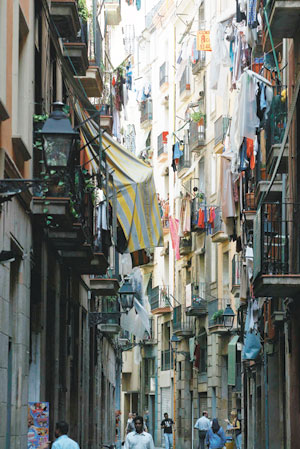
The Raval neighbourhood was historically the slum of the ancient Barcelona. However, it has become the most fashionable area in the city. Lots of bohemian and cool bars and clubs now fill its alleyways. If you are into new tendencies, the Barcelona Raval is your quarter! But it is still a good idea to take care with your wallet and backpack at night. It has a unique personality that makes it special. Although it is an exciting area in the city, it also has its darker side.

The Raval neighbourhood represents a refreshing and authentic area of Barcelona. It used to be the famous Barcelona's red-light district. The government started an urban regeneration project for the Olympics to clean up the area and becomes it safer. But there are still some unsafe areas, where drugs, theft and prostitution continue. However, it is a vibrant, lively and multicultural quarter!

It enjoys has a multitude of fashionable and ethnic restaurants, pubs, clubs and bars and a wide variety of art studios, galleries, such as the famous MACBA (museum of modern art) and CCCB (an exhibition centre). There are lot of shops, and unique boutiques that you'll find only in the area. Here you'll find the small privately owned shops!

Discover the Rambla del Raval. This is a new space gained to the neighbourhood. This is a lovely avenue, dominated by Arab people. Hence, this quarter is also known as the Little Islamabad or as Ravalkistan. In this quarter there live foreign families, especially from Morocco, Pakistan, India, Bangla Desh and South America...

The Marsella bar is a mandatory stop (Sant Pau street). First it was a distinguished coffee for high class Gentlemen, but eventually it became the central point of the singles scene. Another treasures in the Sant Pau Street are the beautiful modernist decorations of the Hotel Spain lounges, designed by Domenech i Muntaner.

The Raval neighbourhood is a fascinating quarter. Discover it wondering through its small narrowstreets, or as they used to say in Barcelona, "ravaleando". Rent Barcelona Apartments for the best stay in the city.

Monday, March 9, 2009

When Football Raises Passions - Barca Vs Real Madrid


Football is for many people much more than sport. This has become the most popular game on the planet, with nearly 270 million people participating in one way or another. In Spain, soccer moves astronomical amounts of money on advertising alone, with Barça and Real Madrid with the most capital invested in promotion. In addition, these two clubs have the most followers. Even their players have become media stars just like singers and actors.

In fact, the enthusiasm for football in Spain has reached astonishing levels: the stadiums of both teams are among the most visited attractions in both cities. In addition, the Museum of Barcelona FC is the most visited museum in Catalonia, ahead of other well-known ones such as the Dalí museum.

Barca and Real Madrid are two of the most famous teams in the world and in our country they have always been eternal rivals. Madrid was named Best Club of the century by FIFA in 2000. they have won 31 league titles, 17 Copa del Rey, 8 Spanish Super Cups, 9 Champion's Leagues, 2 UEFA Cups, 1 European Supercup and Intercontinental Cups 3.

Considering Barça, it has been the only European team that has played continuously in the continental competitions since its beginnings in 1955. Moreover, it has attained 18 league titles, 24 Copas del Rey, 7 Spanish Super Cups, 2 European Super Cups, 2 Champion's League titles, 4 European Cup Winner's Cups and 3 European Fairs Cups among others.

Both Culès as well as Meringues have been blessed with the best soccer stars. Barca have signed players such as Messi, Cruyff, Maradona, Laudrup, Ronaldinho or Kubala, while Real Madrid have signed stars such as Zidane, Di Stefano, Casillas, Raul, Ronaldo and Puskas.

At the moment FC Barcelona and Real Madrid are fighting for the top two positions in the table with Barcelona ahead by just a few points. What seemed impossible a few days ago when a seemingly invincible Barça were 12 points ahead, is now much more of a target for Real Madrid.

We will have to wait until 3rd May for the eternal rivals to face each other again. Undoubtedly, it will be a game to provoke heart attacks as one side is speaking of a crisis in the Barça camp while the whites are enjoying a good run of unbeaten games.

Does anyone dare to bet on who will win the league? With so few days to go until the end of the league, emotions are running at an all time high. The match will be played at the Santiago Bernabeu in Madrid so why not enjoy the game in style - rent the best apartments in Madrid so as not to miss a thing!

Monday, March 2, 2009

Sintra - A Fantastic City


Sintra is one of the most beautiful towns in Europe. It belongs to Portugal and it is located close to Lisbon. It was known in ancient times as Mons Lunae (the Hills of the Moon), because of its strong traditions in astral cults. Sintra has been declared World Heritage by UNESCO due to the large amount of archaeological remains and monuments it has.

It is a very tourist town because it enjoys of a rich cultural heritage. It tourist potentialities also include the three National Palaces: Palácio da Vila and Palácio de Queluz and Palácio da Pena, in addition to the municipal museums. It also includes the quarries producing marble, winegrowing, the confectionery and gastronomy and the handicraft workshops.

Thanks to its unique combination of castles, parks and gardens, Sintra enjoys a beautiful and unusual geography. The city centre is about 15 minutes by walk from the train station. The Sintra's heart is a real gem: everything there seems as if you were in a fairy tale. There is a wonderful Toy Museum for young and old people, lots of craft shops, pastry shops and restaurants. The Jardins de Monserrate are a must. They have a huge variety of subtropical plants and exotic trees. Not to be missed are the palaces of Seteais and Monserrate and the Moorish Castle dates from the 8th century.

There are any other mandatory places to visit: the Convento dos Capuchos, : the 12th Century Igreja de Santa Maria or some several private palaces that are open to the public: the Palácio de Seteais, a magnificent 18th Century home transformed into a five star Hotel; Casa dos Ribafrias, a 16th Century building Quinta de Pena Verde, another 16th Century palace, and the Palácio de Monserrate, built in the 19th Century.

There are also many museums to visit: the Casa Museu Leal de Câmara, which shows the Palace's art works; the Museu Regional, which shows the area's history; Museu de Arte Moderna, the Casa Museu Dorita Castel Branco and the Galeria de Arte Municipal among others.

Sintra lies along a wonderful coast, so it has beautiful beaches. Do you need any other reason to go to Portugal? Take the first train to Sintra and rent Lisbon Apartment. As Robert Southey once wrote: "Sintra is the most blessed place of all the habitable world".

Tuesday, February 24, 2009

The Dali Mustache


Salvador Dali is the world famous and greatest of surrealist painters. Smart, sharp and brilliant, he was the Artist of the artists. His moustache said a lot about him: Dali was a genius of originality and authenticity. He was highly imaginative, and had a great eagerness for having an unusual and grandiose behaviour, in order to draw attention to himself.

Dali was born in Figueres (Catalonia) in 1904. As an adult, he made his home with his wife and muse Gala in nearby Port Lligat, but he lived in Barcelona, Madrid, Paris and USA too. He was a very versatile artist, not limiting himself only to painting: he used to do sculptures, and he is also famous for his contributions to fashion, theatre and photography. His painting skills are often attributed to the influence of Renaissance masters.

In 1921 he moved to the student residences at the School of Fine Arts in Madrid (but he was expelled in 1926, due to his final exams, when he said that no one on the faculty was competent enough to examine him) and ten years later he was yet the genius that we all know: he had collaborated on a short film with Luis Buñuel; he had officially joined the surrealist group in Paris where he painted his most famous work, The Persistence of Memory, which almost stands alone as a symbol of the movement.

After some years he was expelled from the Surrealist movement because they considered he has become too commercial and that he just wanted to attract attention to himself. And maybe this is what he wanted, because he titled his autobiography Diary of a Genius. However, he continued exhibiting his surrealist works all over the world.

In 1940 Dali shifted to a new type of painting which was more concentrated on science, religion and even history. He and Gala escaped from World War II to the United States (1940-1948) and he acquainted himself with his classic period: he painted a series of 19 large canvases, among the best known are The Hallucinogenic Toreador, and The Discovery of America by Christopher Columbus and The Sacrament of the Last Supper. These were very important years for the artist.

In 1949, Dalí wnt back to his beloved Catalonia, where he spent his remaining years. In 1974, he opened his famous Teatro Museo in Figueres. Late in his career, he moved around other areas in addition to painting: he experimented with many unusual or novel ideas. For example, he designed the Chupa Chups logo and even created the advertising for the 1969 Eurovision Song Contest.

Gala died on June 10, 1982. After Gala's death, Dali's health began to fail. He moved from Figueres to the castle in Púbol, which he had bought for Gala and was the site of her death. In November 1988, he was admitted to hospital with heart failure, and he died on January 23rd, 1989 from a second heart failure.
This excellent and creative artist will always be an art standard. He is unique, he is a genius, he is Salvador Dali! If you want to learn more about him travel to Catalonia and rent Apartments in Barcelona. It will be an exciting experience!

Seville - When the Food Becomes "Tapa"


Sevillian dishes are simple, but made of an exquisite quality. One of his best qualities is his artisan touch as this is real home cooking. The Sevillian history and gastronomy are closely linked. This way, it has Arabs influences (which have bequeathed spices like fennel, peppermint, garlic, coriander or parsley) and Mediterranean influences (where olive oil is the king ingredient).

Typical dishes include "gazpacho" (a cold tomato soup), flamenco eggs (eggs poached in tomato sauce), tiny fried fish, "cocido andaluz" (a thick stew made of meat, chickpeas and vegetables), "menudo" (Andalusian styled tripe), "ensaladilla sevillana" (variation of potato salad) and the famous bull's tail

But the real centre of the Sevillian food are "tapas". The "tapeo" practice allows the visitor to try a great variety of dishes in a single meal. There are thousands of "tapas" to try, among the most consumed are: "boquerones en vinagre" (small marinated fish in vinegar), "ensaladilla" (a version of a Russian potato salad), Spanish hams and cheeses, "papas aliñás" (seasoned potatoes), "salmorejo" (a thick "gazpacho"), "lomo mechado" (loin strips), "aliño" (various seasoned meats), "picadillo" (minced meat) and "tortilla de patatas" (Spanish potato omelet). Other typical ones consist of of "pucheros" (stews), "flamenquines cordobeses" (ham stuffed breaded/fried meat rolls), "soldaditos de pavía" (hake or cod breaded with flour) and "montaditos" (a type of small toasted rolls or sandwiches usually filled with sausage or other ingredients). "Tapeo" is a social act in Seville.

In Santa Cruz neighbourhood you'll taste the most delicious "tapas" in the city. If you want to eat on a terrace go to Alfama and if you want to eat in front of the Guadalquivir River go to Triana. Arenal quarter provides more traditional establishments, offering a fine selection of fresh fish

The best wines are the Manzanilla and the Montilla. But Jerez (sherry) is delicious too. If you want something lighter you can have a cold lager beer.

Most Sevillian pastries are an Arab legacy and are made of wine or Money, as the "tortas de aceite" (thin large rounded pastries made with olive oil) or the "polvorones" (typically eaten in Christmas). The great part of the Sevillian sweets is made on the city convents, especially for the Holly Week. The most famous pastries are: the "San Leandro Yemas" (sweet egg yolk cakes), "torrijas" (similar to a French toast), homemade marmalades, "borrachuelos" (a sweet made with honey, sweet wine, aniseed and bitter oranges), the "tocinos de cielo" (a pudding made with egg yolk and syrup), "alfajores" (almond and nut pastries) and cider pastries.

Don't you want to taste the Sevillian "tapas"? Rent Seville Apartments and enjoy your stay in this beautiful city.

Monday, February 16, 2009

Valencia - Paella, Horchata and Other Delicatessen


The Valencian cuisine is based on the healthy Mediterranean diet, which has the best natural products extracted from the garden or the sea, such as seafood, fruits and vegetables or wine. It enjoys of many different flavours and exquisite textures. But, undoubtedly, the protagonist of the dishes is the paella, considered a national symbol.

Despite it culinary diversity, the rice monopolises most Valencian menus. But the repertoire of Valencian rice dishes is not a monotonous succession of paellas: rice is cooked in many ways. Many chefs argue that the original paella recipe was made of chicken, snails and vegetables (Paella a la Valenciana). Now everything has change!

The most common paella is the Marinera one, cooked with saffron, sea-food, fish and vegetables and of course, rice. If you add chicken, it would be a Paella Mixta. Nonetheless, the traditional paella has diverged in many other recipes: "arròs negre" (rice with ink squid), "arròs a banda" (rice with seafood), "arròs amb fesols i naps" (with haricot beans and turnip), "arròs al forn" (oven-baked rice), "arròs amb bledes" (rice with chard)... "Fideuà" is similar to paella, but the rice has been replaced by noodles.

In addition to the rice, the Valencian Gastronomy has many other specialities such as the "all-i-pebre d'anguiles" (garlic,pepper and eel stew), "suc de peix" (made of fish, oil, garlic, onion and parsley), "esgarrat" (roasted red pepper, cod and olive oil) and "titaína" (a recipe made of vegetables, pine kernels, spices and tuna).

The Valencia'n desserts are also varied and delicious, some of them inherited from the Moorish culture: the "arnadí", made with pumpkin preserves, yams and almond or the pastries made of the extract of a kind of sweet potato called a "boniato" and "cabello de angel". In addition, Valencia has the best oranges in Spain, which are exported to the rest of the country.

There are two typical drinks: horchata (a delicious ice cold beverage made of tiger nut milk) and Valencian Water (a cocktail made from orange juice and Cava). Valencia also has great red and white wines.

There is no doubt that Valencia is a great cuisine capital. Discover it and enjoy your stay there! Ren Valencia Apartmetns for the best accommodation.

Gaudi - The Greatest Architect


Gaudí is probably the greatest Spanish architect of all time. He is considered the king of the Modernist movement (Art Nouveau). His work is a clear product of the cultural context of his time, his own personality and his devotion to the Catalan society.

He was born in Reus in 1852, but he took his professional life in Barcelona. Gaudí's biography is closely related to Barcelona and to the Güell family, which move around the most prestige circles at this time. He built most of his most important works such as the Palau Güell, the Park Güell or the Colonia Güell for this family.

But besides of being a great architect, he was a great designer too: he always looked after architectural space with organic decorative concept using furniture, stained glass, wrought iron, ceramics, mosaics, and so on. He added colour to his buildings, a concept which is often overlooked by his colleagues. Gaudi's buildings were greatly influenced by forms of nature and especially by the sea, so all his work has an important symmetry absence. As in nature, nothing in his buildings or furniture is absolutely identical.

Gaudí's most representative architecture works are:

Sagrada Familia: this was his most ambitious project, but he left it unfinished in 1926 when he died. From 1908 until his dead he worked on no other projects. This monumental church is Gaudi's most famous work and a worldwide symbol of Barcelona.

Parc Güell: Eusebi Güell wanted to create a stylish park for Barcelona's aristocracy and Gaudí built it for him. It has the most beautiful buildings, sculptures, and tile work you've ever seen, and a small museum, which was the old Gaudís's home. UNESCO declared the Parc Güell a place of World Heritage in 1984.

Casa Batlló: it is known for its elaborate decoration and forms derived from nature. It looks like it has been bade of bones and skulls. This beautiful building is located in Passeig de Gracia, one of the biggest commercial streets of Barcelona.

Casa Milá: it is know as La Pedrera because of its cliff-like façade. It was built for the Milá family between 1906 and 1910 and classified as World Heritage by UNESCO IN 1984. It balconies resemble seaweed and the undulating wall the sea.

There are some of Gaudi's lesser-known works that you shouldn't miss such as the Gigantic fountain (Parc de la Cuitadella), the Three Graces Fountain (Plaça Reial) and the amazing wrought-iron embellished street lamps that line the streets in the heart of the city

Gaudí died in Barcelona run over by a tram on 10th June 1926.

Do you want to enjoy the greatest Gaudí's architecture buildings in Barcelona? Travel to Spain and discover them! And for the best accommodation rent Barcelona Apartments.

Friday, February 13, 2009

Lisbon by Night


Lisbon is magical during the day and intense at night. It is an amazing city that captivates everyone who visits it. The Lisbon sunsets promise a long night full of fun. Late in the evening, the Chiado district coffees open their doors for the most impatient people. In fact, Lisbon is becoming one of the European nightlife capitals due to its variety and quality.

The Barrio Alto has been the traditional nightlife area in Lisbon. This is the favourite Lusos' area to begin the night. Among its main attractions there are the fado locals and some of the most charming bars of the city. This is a very particular neighbourhood, full of little streets with tiny bars. There people use to pile in the local's doors drinking and talking. The "pretinha" (black beer) is the typical drink of the Barrio Alto, but they use to drinkd all kind of the "caipirinha" too. About four in the morning tha Barrio Alto bars use to close and people go to other nightlife areas!

The Alfama neighbourhood is the most authentic Lisbon quarter: it offers a different night, full of curious places. Alfama is the cradle of the fados and probably the best place to listen to them. We are talking about a bohemian quarter, with the best old bars in the city. To wander around its beautiful streets is the best way to discover the Alfama night treasures.

Much of the Lisbon nightlife has moved to the Docas de Santo Amaro neighbourhood, situated next to the Ponte April 25. It is the most fashion area of Lisbon, with the most glamorous and expensive clubs and bars, suitable for all tastes. There are three famous discos: the Capital disco (Avenida 24 da Julio, 68), the Kremlin dico (Rua Escadinhas da Praia, 5) and the Lux disco (Rua Gustavo Matos Sequeira, 42), owned by John Malkovich. Another one is the African club B.Leza (Conde Barão, 50), with the most exotic ambience and the best Afro-Portuguese rhythms

Another good place to go is the the former Expo 98 fairground (Parque das Naçoes). A multitude of cultural and musical events are celebrated here! For people who prefer other night time activities, the Estoril Casino is the best alternative (Praça José Teodoro dos Santos Estoril).

Travel to Lisbom and enjoy of the best nightlife there. You'll have a great time! Look after Lisbon Apartments for a perfect accommodation.

Thursday, February 12, 2009

Milan Gastronomy

Milan Gastronomy

Posted using ShareThis

Milan Gastronomy


Are rice and cheese your favourite foods? If you have said "yes", Milan is a city specially designed for you. Traditional Milanese cooking is made up of simple, but delicious dishes. On the other hand, Milan's passion for fashion extends to the dinner table: it is full of restaurants with the newest foodie trends. Finding a good restaurant to spend a pleasant night in a beautiful environment, with a perfect service, and a delicious meal, is quite easy in this city.

Italian food tends to be deeply regional, with the different cities having their own signature dishes and ingredients. Milan, however, has been influenced by the massive influx of the industrial boom workers, so it has influences from both Sicily and Tuscany. But this doesn't mean that Milanese cuisine doesn't have its own distinctive flavour.

Unlike most Italian regions, Lombardy prefers a northern European custom: using butter rather than oil as its cooking medium, which gives a special and distinctive taste to their cuisine. Alla Milanese-style cooking means that the food is usually dipped in egg and breadcrumbs mixed with grated Parmesan then sautéed in butter.

Their most popular dish is Rissotto, often made with meat. Pasta is very popular too, but it's usually baked or stuffed with cheese or meat. They love all kinds of cheeses, but Gorgonzola is their favourite. Mascarpone is also a typical Milanese cheese and appears regularly in puddings, desserts or creams. Another popular speciality is osso buco, always accompanied by risotto. Meat is very common on many menus, especially veal and pork. They usually eat fish too, particularly trout and pike, straight from the many lakes in northern Italy. Don't forget to taste the "cassouela", an extremely filling dish made with various parts of pork meat (tail, ribs, rind, feet and ears) cooked with green cabbage and other vegetables.

Finally, Panettone is a sweet type of bread with raisins, citron, and anise which hails from the Milan area, but enjoyed throughout Italy. It is the traditional Italian Christmas cake, although there's nothing to stop visitors ending their meal with a generous wedge of the fruit-studded bread at any time of the year. Another typical dessert is the Torta di tagliatelle, a sweet cake made from egg pasta and almonds.

Pizzerias are very popular in the city. They are usually cooked in wood-fired ovens, giving them a delicious smoked taste. Some of these pizzerias have traditional paper tablecloths and provide you with pencils to amuse yourself while waiting for your pizza.

Do you want to taste the most traditional Milanese food in a traditional trattoria? Take a flight to Italy and rent Milan Apartments for the best accommodation. If you are planning to visit this city, don't miss out on trying some of their typical food.

Tuesday, February 10, 2009

Valencia will host again the America’s Cup competition


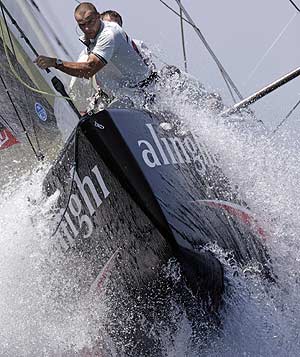
Valencia will host once again, for the second consecutive year, the America’s Cup. The America’s sailing Cup is the oldest sailing competition in the world and the third most watched sport event on the planet, after the World Cup and the Olympics. This year it will celebrate its 33rd edition in the Mediterranean waters.

The America’s Cup celebration dates back to 1851. It was created during the Great Universal Exhibition in London. Then the winner received a silver trophy designed by Robert Garrard (the royal family jeweller), valued at 100 gold guineas. That's why it is also known as "the 100 Guineas Cup".

After months doubting about where to hold this year’s race, Ernesto Bertarelli (skipper and owner of Alinghi, the winning team of the past edition) met with Zapatero to sign an agreement of 110 million euros. This money will be divided among the three America's Cup Management administrations, the company who is organizing the races. Every year, the previous winning team decides which will be the headquarters of the next competition.

Following the huge public success that the event enjoyed and the flawless image that it left behind last year in Valencia, the Government has invested more money for the competition. With this invested money, they will lengthen the maritime walkway, construct new docks for the Bertarelli America's Cup and remove and repair some buildings to improve the area’s image.

This year will hold two different events, one in June and the other in July, to make them coincide with the suitable wind conditions. In April the Rolex Cup will begin, the new sponsor of these playoffs. There, all the candidates will face Alinghi (the Swiss team).

This edition tries to make the yacht races longer than the past year. With this in mind, they will use just one leg per day, instead of two, as has happened in the past.

The first title defence was in 1870. The Americans remained invincible until 1983, when they were defeated by Australia II, the Royal Perth Yacht Club. But it took only one year for the Americans to regain the title, until in 1995 the New Zealand Team beat them again. But in 2003 the Alinghi Team (the Geneva Nautical Society) got the victory. It was the first winning team without access to the sea, so they chose Valencia as their headquarters to defend their title. As Switzerland won again, they chose for the second time Valencia as the 2009 America’s Cup headquarters.

Don’t miss one of the major sporting events in the world. Rent Valencia Apartments to feel as if you were at home. You’ll have a great time there!
 
Blog Information Profile for fernandoseo
Bookmark and Share Add to Technorati Favorites